Thursday, April 5, 2012

When Publishing Changes, So Does Society: Medical Practice and Patient Empowerment from the Printing Press to Web 2.0


Assignment Three - Judith Dyck


The introduction of the Gutenberg printing press amplified the “amount and variety of what was available and accessible to readers” (Nutton, 2005, p. 426). This increased what Graf (2011) calls the “flow of communications” and provided increasing numbers of people with access to information (p. 87). The corresponding parallel today is the rising availability of access to information and connectivity via the internet, with its search engines, volumes of webpages and social media tools.

Health Information Post-Gutenberg into the 1500s
When the printing press came into wide use in fifteenth century Europe, it had a significant impact on the spread of health information, both to physicians and to literate households in Europe. Books were already part of the physicians’ culture, but lay people also began purchasing books containing information on anatomy, recipes for medicines and advice on treatment of illness and infirmity (Nutton, 2005, pp. 422, 426 – 427). This transfer of medical learning to a wider audience “democratized” the information: Physicians who didn’t reside in university centers and households across Europe could readily share in knowledge from previous centuries, as well as new information as it became available (Nutton, 2005, pp. 427- 428). 

For households, the desire for health information was partially driven by a desire to avoid or treat disease, as can be seen by the proliferation of plague tracts.  In the mid-1400s, Europe was emerging from a century of plague and outbreaks still occurred. This led people to seek advice from physicians and universities and provided a market for plague tracts on how to avoid and treat the disease (Nutton, 2005, p. 433). Over 500 known from the 1500s still exist and comprise seven percent of known medical printing from the time, speaking to their popularity. Many were printed in everyday languages such as Dutch, German and French and are often in poor condition, attesting to their use. This is in contrast to more costly illustrated editions of medical works, which are often found in pristine unread condition and published in Latin, the language of the scholar (Nutton, 2005, pp. 423, 431 - 432). The abundance and use of plague tracts demonstrates that the power of the printing press in spreading medical information beyond the community of physicians, or as Mumford (2011) said, “...printing broke the class monopoly of the written word” (p. 77). More information can be found in the blog posting at http://www.lib.cam.ac.uk/deptserv/rarebooks/incblog/?cat=77

From the Printing Press to the World Wide Web
Similarly, publishing on the internet has democratized the availability of health information today. Health care in North America in the 20th century was largely organized through institutions and professional groups. Physicians acted as gatekeepers and people were recipients of healthcare, rather than participants. Web 2.0 and online publishing are breaking down those barriers. Information formerly unavailable to lay people is now readily accessible. This is providing people with the information and tools needed in order to control their health care (Eysenbach, Sa & Diepgen, 1999; Jadad, 1999; in Hordern, Georgious, Whetton & Prgomet, 2011, p. 6). 

Access to social media and information published online can help bridge the gap between the doctor’s office and the life of the person with a chronic condition, supporting them in leading the healthiest life possible for them. Hordern et al. (2011) identified five areas in which the internet is playing a part in consumer health and changing people’s expectations of the system and their own response to health concerns: 
  • Online support groups;
  • Self management and monitoring applications;
  • Tools to assist in decision making; 
  •  Personal health records; and
  •  Internet use (p. 7).
Online support groups are forums where people with similar health concerns can gather to share information and offer and receive support (Bane, Haymaker & Zinchuk, 2005; in Hordern et al, 2011, p. 5). As a result of their online interactions, people report that they feel better able to manage their condition, have better health outcomes and are less lonely (White & Dorman, 2001; in Hordern et. al, 2011, p. 7). Still, online support groups are rarely overseen by healthcare practitioners and there is the potential for erroneous information or procedures not rigorously tested becoming inculcated and putting people at risk (Winzelberg, 1997; Dickerson, Flaig & Kennedy, 2000; in Hordern et al, 2011, p. 7). Go to http://www.healingwell.com/ for an example of an online support portal or to http://www.mayoclinic.com/health/personal-cancer-blog/MY02059 for an article on starting a blog as a way of coping with a disease.

Self monitoring (e.g. checking blood pressure at home) and self management of chronic diseases have been linked to improved quality of life and can help people follow the recommended guidelines for their condition (Harris et al., 2008; in Hordern et al, 2011, p. 8). However, self monitoring in some instances has been shown to lower quality of life, with people reporting higher levels of distress, worry and depression than people not self-monitoring (Franciosi et al., 2001, in Hordern et al., 2011, p. 9). This would indicate the need for greater professional oversight to ensure that the monitoring has a beneficial effect.
Online tools to help people make decisions about different courses of treatment have some of the same benefit/drawback features of online support groups and monitoring. While they can assist in better decision making, they aren’t sensitive to individual health histories and personal circumstances (O’Connor et al., 2003; Billings, 2004; Woolf et al. 2005; in Hordern et al., 2011).

In a personal health record (PHR), the individual owns and manages their health information collected from a variety of sources, in contrast to the more common electronic health record which is controlled by a health provider or organization. In various studies, people have indicated that they would find a PHR useful, would be empowered by having access to their information and would be better able to manage their care (Hordern et al., 2011, p. 10). Employers in the U.S. are increasingly opening the door to their employees having a PHR as a way to support healthy living  (http://www.technologyreview.com/biomedicine/38100/, n.d.). 

People also use the internet to acquire health information from published sites –Mayo Clinic runs such a site at http://www.mayoclinic.com/health-information/. At times, they use the internet after seeing a health provider to get more information and better understand the diagnosis and treatment plan they have been given (Gauld, 2011; in Hordern et. al, 2011, p. 11). Sommerhalder et al. (2009) found that practitioners felt that patients who sought out information on the internet were better informed and posited that when the practitioner and patient discussed the information found on the internet, patients were better able to personalize their treatment plan and empowered to take responsibility for their care and health outcomes (in Hordern et al, 2011, p. 11). Eland-de Kok, van Os-Medendorp, Vergouwe-Meijer, Bruijnzeel-Koomen & Ros (2011) found that chronically ill patients showed some slightly better results when they were offered e-health interventions instead of or in addition to other primary care (p. 1). 

Implications for the Future
Seth Godin says the internet turns scarcity into abundance and that is certainly true of health information on the internet (http://www.cbc.ca/q/episodes/, n.d.). On a different scale, but still at meaningful levels, the printing press had the same effect. Just as the change in publishing technology did during the Renaissance, publishing on the internet and Web 2.0 tools are changing people’s relationship to health providers, empowering them to better manage and participate in their own healthcare. This access is showing signs of helping to improve health outcomes. People have always had a greater awareness about how they are feeling than anyone else could possibly have. Self-knowledge armed with the information and tools of the internet could actually be heralding something other than the oft noted age of the amateur – the empowered self-expert.

This isn’t a signal that the era of medical experts is over, but it is changing their role. Depending on how health care professionals respond to the new dynamic, an empowered patient and technologically equipped health care provider could provide stronger ties and more effective interventions. This will require a higher level of digital literacy amongst health professionals. While this might be expected as something that will develop as a matter of course as people born in the age of the internet start to enter the professions, Hanik & Stellefson (2011) found that students enrolled in health education at the undergraduate level had lower than optimal levels of e-health literacy (p.2). Deliberate education in digital literacy will be required.
The biggest disconnect appears to occur in the area of digitally mediated patient contact with their provider (See table one). Greater participation by providers in the conversation could increase the benefit of digitally mediated interactions. Consider the example of a patient with epilepsy. The patient’s neurologist provides her with access to an epilepsy nurse and a digital app called My Epilepsy Diary (http://www.epilepsy.com/seizurediary, n.d.). These are good tools and services. However, the digital diary isn’t electronically accessible to the nurse or physician and thus they can’t monitor her condition remotely or receive alerts when she is having problems. There is no way for the patient to contact the nurse other than by phone – no e-mail, no texting, etc. When the patient experiences a seizure, she finds it very difficult to collect her thoughts for a phone call and leaving a message is even more stressful. However, she’s young and hip and doesn’t experience the same issues with texting or email (personal communication, n.d.). The lack of transliteracy on the part of the provider is a barrier to care when it critically required by the patient.

Table One


E-Health Format
Type of E-Health Interaction
Patient to patient
Patient to web-based information or app
Digitally mediated patient-provider
contact
Provider/health expert to internet
Online support groups
Yes
Yes
No
No
Self management and monitoring applications
No
Yes
If it occurs, not always digitally mediated
Yes
Tools to assist in decision making

No
Yes
If it occurs, not always digitally mediated
Yes, in preparation of the tool
Personal health records
No
Yes
No
Yes
Internet use to access information
No
Yes
No
Yes

Conclusions
Using e-health tools to connect the patient with the provider may be where the biggest improvements to health outcomes will be found. Social media tools have the potential to provide a powerful feedback loop or virtuous cycle of care between patients, their own actions, their interactions with e-health tools and information, and practitioners. Health experts are sitting outside the loop at present and while they are feeding information into the loop, they are not monitoring its effect in the same way. 

Just as the printing press put health information into the hands of consumers during the Renaissance, the new publishing technology of the internet is doing the same today. Its impact on health outcomes is only beginning to be understood. Disconnects between the health expert, the online community, information published on the internet and consumers need to be bridged. 

References
CBC Radio. (April 3, 2012). Accessed from http://www.cbc.ca/q/episodes/

Epilepsy therapy project. (n.d.). Accessed from http://www.epilepsy.com/seizurediary

Eland-de Kok, P., van Os-Medendorp,H., Vergouwe-Meijer, A., Bruijnzeel-Koomen, C., Ros, W. (2011). A systematic review of the effects of e-health on chronically ill patients. Journal of Clinical Nursing, 2011 Nov; 20(21/22): 2997-3010

Graf, H. (2011). Early modern literacies. In D. Crowley and P. Heyer (Eds.), Communication in history: Technology, culture, society (pp. 86–95). Boston: Allyn & Bacon

Hanik, B., Stellefson, M. (2011). E-health literacy competencies among undergraduate health education students: A preliminary study. International Electronic Journal of Health Education, v14 pp. 46-58, 2011. Retrieved from http://ehis.ebscohost.com.login.ezproxy.library.ualberta.ca

Hordern, A., Georgious, A., Whetton, S., Prgomet, M. (2011). Consumer e-health: An overview of research evidence and implications for future policy. Health Information Management Journal Vol 40 No 2 2011, pp. 6-14. Accessed March22, 2011 from http://www.ncbi.nlm.nih.gov/pubmed/21712556

Mumford, L. (2011). The invention of printing. In D. Crowley and P. Heyer (Eds.), Communication in history: Technology, culture, society (pp. 74-86). Boston: Allyn & Bacon

Nutton, V. (2005). Books, printing and medicine in the Renaissance. Medicina nei Secoli: Arte e Scienza, 2005,Vol. 17 Issue 2, pp. 421 – 442. Journal of History of Medicine.


Sources for images used in the podcast

Gutenberg Printing Press.Accessed from  http://www.google.ca/imgres?q=gutenberg+printing+press&hl=en&client=firefox-a&rls=org.mozilla:en-US:official&biw=1280&bih=812&tbm=isch&tbnid=9_uCZGgkiYiVMM:&imgrefurl=http://www.printsourceinfo.com/OffsetPrinting.html&docid=n92-q2iithL-xM&imgurl=http://www.printsourceinfo.com/gutenberg_11358_lg.gif&w=578&h=700&ei=0dl9T-2LNIGoiQLClbCGDg&zoom=1&iact=rc&dur=669&sig=118407030946307309508&page=1&tbnh=138&tbnw=114&start=0&ndsp=31&ved=1t:429,r:19,s:0,i:131&tx=68&ty=92

Elyot, Thomas, Sir, 1490?-1546. Castel of Helth.
Page Turner - PDF (90.6 MB) - Bibliographic Information

Diabetes Checklist. Accessed from
http://www.google.ca/imgres?num=10&um=1&hl=en&client=firefox-a&rls=org.mozilla:en-US:official&authuser=0&biw=2560&bih=1306&tbm=isch&tbnid=rG_nNG8vBrUjwM:&imgrefurl=http://www.diabetesdayton.org/Blog&docid=XHUTjUYMJtouLM&imgurl=http://www.diabetesdayton.org/sites/default/files/diabetes-checklist-stock-588px.jpeg&w=588&h=400&ei=3Oh9T4HVDcSbiALf3f37DQ&zoom=1&iact=hc&vpx=379&vpy=157&dur=633&hovh=112&hovw=165&tx=135&ty=77&sig=107078245025850618944&page=1&tbnh=112&tbnw=165&start=0&ndsp=121&ved=1t:429,r:2,s:0,i:68

Man, Doctor & Stethoscope. Accessed from
http://www.google.ca/imgres?um=1&hl=en&client=firefox-a&rls=org.mozilla:en-US:official&authuser=0&biw=2560&bih=1306&tbm=isch&tbnid=f8MxuRg2EDFHfM:&imgrefurl=http://www.topnews.in/health/depressed-men-erectile-dysfunction-face-cardio-problems-28076&docid=tWoO_c_c2A-tRM&imgurl=http://topnews.in/health/files/cardiac-problems.jpg&w=292&h=219&ei=JOl9T6btO4mPiAKoxq3lDQ&zoom=1&iact=hc&vpx=1100&vpy=288&dur=116&hovh=175&hovw=233&tx=157&ty=116&sig=107078245025850618944&page=1&tbnh=119&tbnw=159&start=0&ndsp=118&ved=1t:429,r:23,s:0,i:111

Man on Scale. Accessed from
http://www.google.ca/imgres?start=122&num=10&um=1&hl=en&client=firefox-a&rls=org.mozilla:en-US:official&authuser=0&biw=2560&bih=1306&tbm=isch&tbnid=T1jXIiE8vEsEDM:&imgrefurl=http://www.viewzone.com/obesity.html&docid=znaqkfiacAntdM&imgurl=http://www.viewzone.com/obesity2.jpg&w=265&h=182&ei=kOh9T4ujMYfmiALC9qT8DQ&zoom=1&iact=hc&vpx=995&vpy=362&dur=264&hovh=145&hovw=212&tx=139&ty=109&sig=107078245025850618944&sqi=2&page=2&tbnh=129&tbnw=173&ndsp=133&ved=1t:429,r:5,s:122,i:154

Woman testing blood sugar. Accessed from
http://www.google.ca/imgres?start=0&um=1&hl=en&client=firefox-a&sa=X&rls=org.mozilla:en-US:official&authuser=0&biw=2560&bih=1306&tbm=isch&tbnid=xe36sdHrvhRRoM:&imgrefurl=http://foxync.com/elev8-health/diabetes/toneal/type-2-diabetes-testing-which-ones-are-most-important/&docid=lMW8lXb2ThgRvM&imgurl=http://crosspost.interactiveone.com/files/2010/04/diabetes_testing.jpg&w=506&h=338&ei=ful9T_iyIMSfiALF8LmlDg&zoom=1&iact=hc&vpx=509&vpy=865&dur=41&hovh=183&hovw=275&tx=65&ty=80&sig=107078245025850618944&page=1&tbnh=134&tbnw=179&ndsp=118&ved=1t:429,r:77,s:0,i:9

Woman and health professional consulting. Accessed from
http://www.dailymail.co.uk/health/article-1291904/Dont-ask-Dr-Google-How-worryingly-poor-online-medical-advice-affect-health.html

The Networked PHR. Accessed from
http://e-caremanagement.com/connecting-the-dotsgoogle-health-promises-to-create-and-dominate-next-generation-phrs/

eHealth. Accessed from
http://www.google.ca/imgres?q=e-health+google+images&start=115&hl=en&client=firefox-a&sa=X&rls=org.mozilla:en-US:official&biw=1280&bih=848&tbm=isch&prmd=imvnsbfd&tbnid=H4WSU5UzVCVNwM:&imgrefurl=http://www.theaustralian.com.au/australian-it/rush-to-deliver-e-health-eating-1m-a-day/story-e6frgakx-1226245872845&docid=NUqoo9xwfks-0M&imgurl=http://resources0.news.com.au/images/2011/10/19/1226170/974052-e-health.jpg&w=650&h=366&ei=wI99T6O7G6e0iQKp3oT_DQ&zoom=1&iact=hc&vpx=940&vpy=238&dur=8739&hovh=168&hovw=299&tx=208&ty=118&sig=118407030946307309508&page=5&tbnh=108&tbnw=191&ndsp=27&ved=1t:429,r:5,s:115,i:77

Learn more about smart phone apps image. Accessed from
http://medibankmihealth.com.au/healthapps/

BMI/BMR Calculator. Accessed from
http://itunes.apple.com/us/app/bmi-bmr-calculator/id376566232?mt=8


Glucose Buddy. Accessed from
http://itunes.apple.com/us/app/glucose-buddy-diabetes-helper/id294754639?mt=8

Nutrition Facts. Accessed from
http://itunes.apple.com/us/app/nutrition-facts/id317469756?mt=8

Meditate - Meditation Timer. Accessed from
http://itunes.apple.com/us/app/meditate-meditation-timer/id322538701?mt=8

From expert to anyone: the shift from encyclopedia to Wikipedia, and how it affects education

Assignment 3 – Question 3

When Encyclopedia Britannica announced in March that it would no longer produce a print version, the organization promised in a blog post that the encyclopedia would live on, in “more vibrant digital forms,” including its Digital Learning products (Encyclopedia Britannica, March, 2012, para. 6). Britannica has been in business since 1768 and, in its own words, “combines today’s current topics with nearly 250 years of expertise and delivers the depth, breadth, and information that . . . readers have relied on for centuries” (Encyclopedia Britannica, n.d., para. 8). A subscription to Britannica Online Premium service is $69.95 per year.

In contrast, Wikipedia is offered to readers for free and, more significantly, is created by readers, who may or may not include the “Nobel laureates, historians, curators, professors, and other notable experts” that Encyclopedia Britannica relies on for content (Encyclopedia Britannica, n.d., para. 5). It is this defining feature—user participation—which has led to many an educator’s unease with Wikipedia. At the same time, user participation opens on to a panorama of educational opportunities.

The nature of Wikipedia

While Wikipedia is commonly credited with the downfall of the print-based encyclopedia, Anderson (2009) argued that Microsoft was responsible for demonetizing the entire encyclopedia industry through packaging its Encarta product with Windows PCs during the 1990s (p. 130). The introduction of $99 Encarta meant that “once you had a PC in the living room or den where the encyclopedia used to be, it was all over for Mighty Britannica” (Carmody, 2012, para. 12).

Wikipedia had not yet been imagined when Encarta was introduced in 1993. It was not until Nupedia, a free, expert-written, online encyclopedia had failed to thrive that its creators shifted direction and embraced the “radical openness” which gave life to Wikipedia (Reagle, 2010, p. 40).

In comparison to traditional encyclopedias, Wikipedia does indeed appear radically open. The English language Wikipedia lists more than 758,000 editors (Wikipedia Statistics, n.d.), who work for no remuneration. No qualifications are required to enter the community as an editor, who may work under a user name or anonymously. An editor may contribute entire articles or single copy edits. There is no editorial board overseeing content creation; editorial decisions are made by the community. Wikipedia fits Benkler and Nissenbaum’s (2006) “commons-based peer production” model as its production is modular, incremental, and granular, and offers low-cost integration (p. 401).

While “anyone can edit,” Wikipedians are guided by an array of policies and guidelines, including the key requirements of “neutral point of view,” “no orginal research,” and “verifiability” (Wikipedia:Five Pillars, n.d.).

Unease with Wikipedia

By definition, products of the commons-based peer production model are not created by experts. While the model has proven itself successful in creating open source software, unease about a peer-produced encyclopedia remains. This unease has been visible in the realm of education, where a shift in the way knowledge is created, shared, and accessed means a shift in the way teachers and students work together.

At the heart of the unease with Wikipedia are questions about authority and reliability. McHenry (2004), former editor in chief of Encyclopedia Britannica, famously likened Wikipedia to a public restroom, where “one does not know . . . who has used the facilities before him” (last para.). Keen (2007), argued that “Wikipedia claims to be amassing the world’s largest real estate of knowledge, and yet Wikipedia’s readers seem to revel in its very lack of authority” (p. 40).

Reagle (2010), in a discussion about historical shifts in authority, control of knowledge, and knowledge creation, contended that, “the larger anxiety that Wikipedia has triggered is clear, and like that of its predecessors it reflects a broader concern about authority” (p. 152).

The response of some school districts and universities to Wikipedia-related plagiarism and other misuses may reflect the sort of anxiety that Reagle referred to. In some instances during 2007 and 2008, bans on the use of Wikipedia were imposed in response to perceived over-reliance on Wikipedia as a resource (e.g. Olanoff, 2007; Glazowski, 2008).

Since that time, as collaborative online platforms have become more widely accepted and understood as educational tools, many educators have moved away from viewing Wikipedia as little more than an unreliable distraction that threatens the development of proper research skills. Wikipedia has now become seen as “both symbol and agent of a new culture of information consumption, including its production, usage and retrieval” (Luyt et al., 2010, p. 57). As the inherently fluid nature of Wikipedia has become understood, educators are beginning to take advantage of its unique collaborative platform to help students develop critical thinking, writing, and editing skills.

Wikipedia and educational opportunity

Wikipedia, because of its collaboratively-built, consensus-driven editorial process, represents knowledge in a different way than do traditional encyclopedias. Wikipedia articles may represent the view of a single editor, or may represent the views of many. The most widely accepted view may not prevail in Wikipedia articles, as the “neutral point of view” policy allows for the expression of minority views which might not find a place in traditional encyclopedias. A Wikipedia article is also highly subject to change, with particular views becoming more or less prevalent as it evolves. Bruns (2009) notes that traditional encyclopedias “present an edited synthesis of available knowledge . . . and attempt to distill a presentation of ‘the truth’,” while Wikipedia “offers for the user’s own evaluation the various representations of knowledge currently in wider circulation” (p. 132).

The onus placed on the reader to evaluate a Wikipedia article’s representation of knowledge offers a number of opportunities for critical thinking exercises. As an example, an assignment requiring students to evaluate a Wikipedia article on the basis of verifiability would challenge students to consider the references chosen by the Wikipedia editors involved in creating the article, and to consider what other references would be suitable. Similarly, students could be tasked with evaluating whether an article meets the “neutral point of view” standard espoused by Wikipedia, or evaluating how an article has evolved and whether it is improving or being weakened by continuous editing. Through this kind of exercise, students are able to engage much more deeply with encyclopedic material than they would be if using a traditional encyclopedia with a “fixed” representation of knowledge.

Beyond evaluating articles on Wikipedia, many educators are now involving students in creating and editing articles. This kind of work involves the “educational benefits of a traditional research assignment” with the development of “new media literacy skills . . . [and] what it means to collaborate online”, as well as the sense of “contributing to the advance of public knowledge” (Trujillo, 2011, sect. 7).

Because Wikipedia’s breadth is not limited by shelf space or cost of production, it “can harness the enthusiasm of participants with deep knowledge in topical areas whose inclusion in a conventional encyclopedia might be considered frivolous” (Bruns, 2009, p. 122). This potential for development of deep knowledge in a less-travelled topic may present an opportunity for students who are uninspired by traditional academic subjects but are passionate about topics such as gaming or pop culture. The task of creating a Wikipedia article on almost any topic of a student’s choosing can provide an opportunity to develop a range of literacy skills.

Involvement in the Wikipedia community also offers opportunity for observation of a community in action, as an exhaustive record of all discussion regarding articles, policies, and guidelines is maintained on the discussion pages which accompany each page. Shirky (2008) pointed out that: “Wikipedia is the product not of collectivism but of unending argumentation; the corpus grows not from harmonious thought but from constant scrutiny and emendation” (p. 151). Given the constant debate, revising, and reverting that occurs in Wikipedia, consensus building and dispute resolution are essential functions. These functions both echo and depart from the way they are handled in other kinds of communities, and are one example of the many aspects of collaborative communities that can be studied and reflected on.

The Wikimedia Foundation, the organization that oversees Wikipedia, now offers a number of resources through the Wikipedia Education Program for educators who hope to engage their students in work on Wikipedia. Besides offering instructional pages as “Best practices in assigning Wikipedia articles as coursework to students” (Wikimedia Outreach, n.d.), Wikimedia also supports an Ambassador program to help new editors find their way through the interface.

In closing

Few students now see traditional encyclopedias as their starting place for research; Wikipedia is the new first stop. Unlike the encyclopedias it is replacing, Wikipedia does not represent an authoritative and distilled version of knowledge about a topic. Rather, it represents multiple points of view, in a fluid and shifting frame. Reliability is not a given, and the onus is on readers to use the resource with a critical eye. The onus is on educators not to shield students from Wikipedia but to help them understand and engage meaningfully with it.

References

Anderson, C. (2009). De-Monetization. In Free: the Future of a Radical Price (pp. 119-133). New York: Hyperion.

Benkler, Y. & Nissenbaum, H. (2006). Commons-based Peer Production and Virtue. The Journal of Political Philosophy. Vol. 14, No. 4, pp. 394-419.

Bruns, A. (2009). Blogs, Wikipedia, Second Life, and Beyond. New York: Peter Lang Publishing, Inc.

Carmody, T. (2012). Wikipedia Didn’t Kill Britannica. Windows Did. Wired. Retrieved from: http://www.wired.com/epicenter/2012/03/wikipedia-didnt-kill-brittanica-windows-did/

Encyclopedia Britannica. (2012). Change: It’s Okay. Really. Encyclopedia Britannica Blog. Retrieved from: http://www.britannica.com/blogs/2012/03/change/

Encyclopedia Britannica. (n.d.). The Final Print Edition. Retrieved from: http://store.britannica.com/products/ecm001en0

Glazowski, P. (2008). University of Brighton Professor Places Ban on Google and Wikipedia. Mashable, January 13, 2008. Retrieved from: http://mashable.com/2008/01/13/university-of-brighton-professor-places-ban-on-google-and-wikipedia/

Keen, A. (2007). The Noble Amateur. In The Cult of the Amateur: How Today’s Internet is Killing our Culture (pp. 35-63): Doubleday.

Luyt, B., Ally, Y., Low, N. & Ismail, N. (2010). Librarian Perception of Wikipedia: Threats or Opportunities for Librarianship? Libri, Vol 60, pp. 57-64. DOI 10.1515/libr.2010.005. Retrieved from: http://late-dpedago.urv.cat/site_media/papers/libr.pdf

McHenry, R. (2004). The Faith-Based Encyclopedia. Ideas in Action/TCS Daily. Retrieved from: http://www.ideasinactiontv.com/tcs_daily/2004/11/the-faith-based-encyclopedia.html

Olanoff, L. (2007). School officials unite in banning Wikipedia. The Seattle Times, November 21, 2007. Retrieved from: http://seattletimes.nwsource.com/html/living/2004025648_wikipedia21.html

Reagle, J. (2010). Good Faith Collaboration: The Culture of Wikipedia. MIT Press.

Shirky, C. (2008). Here Comes Everybody. New York: Penguin.

Trujillo, M. (2011). Wikipedia and Higher Education—The Infinite Possibilities. Centre for Teaching, Learning and Technology, UBC. Retrieved from: http://ctlt.ubc.ca/2011/11/25/wikipedia-and-higher-education-the-infinite-possibilities/

Wikimedia Outreach. (n.d.) Best practices in assigning Wikipedia articles as coursework to students. Retrieved from: http://outreach.wikimedia.org/wiki/Best_practices_in_assigning_Wikipedia_articles_as_coursework_to_students

Wikipedia:Five Pillars. (n.d.) Retrieved from: http://en.wikipedia.org/wiki/Wikipedia:5P

Wikipedia:Statistics. (n.d.). Retrieved from: http://stats.wikimedia.org/EN/TablesWikipediaEN.htm

Assignment 3 - Remix Culture: Tensions in Vidding


“Vidders” make “vids” also known as fan videos or “fanvids” which are unauthorized videos using clips from TV shows or movies, set to a song.

Surprisingly, vidding was first started in 1975 when a fan named Kandy Fong showed a slide show at a Star Trek convention that used a recording of Leonard Nimoy singing “Both Sides Now”, illustrating Spock's dual human/alien nature. In the 1980’s, vidders (not easily) used two VCRs to capture and edit video clips, then mail copies to other fans. Not until the advent of digital tools and the internet did fanvids become relatively easy to create and publish. Only then did some fanvids become accessible to the public, outside of their “fandom” or fan community.  (Ulaby, 2009)


The fundamental tension that created vidding is the need for fans to interact with the shows that mean a lot to them. Says GS (xgman), “Vidding is love. Artistic love for the values & characters of a show, the music involved & the creative self-expression that comes from marrying these two.” Ana G (AnaG) wrote: “I've always wanted more from TV than to be a passive consumer. Vids really fill in what is missing, a conversation.” (Ulaby, 2009)

A TV series or a movie doesn’t allow for much fan input, either through necessity or choice of the producers. As Chuck writer/producer Phil Klemmer explains, "I don't think there's room for fans' voices in a writers' room. There are already so many voices trying to reach a consensus, inviting the whole world into a writers' room is more chaos than it can bear.” The main reason that fans can't influence shows is due to the lag between when a show is written and when it airs, usually many months. By the time fans react to a particular show or plot change, future episodes are either in production or finished. (Turner, 2012)

The most obvious tension in vidding is around the unauthorized use of copyrighted materials, namely the video footage, and recorded music. There’s the right to ownership of intellectual property versus the need for freedom to appropriate and remix works to create new ideas, and works. If you ask filmmaker Kirby Ferguson, remix is the natural order and evolution of life, “Copy, transform and combine”, and social evolution too, “…but the elements aren’t genes, they’re memes—ideas, behaviors, skills” (Ferguson, 2012). Ferguson reminds us that copyright and patents were introduced to allow the creator to regain the additional cost of development of an original product—that a copy wouldn’t have. After a period of protection, it would then enter the public domain to be built upon and “remixed” as it were into further new concepts and products.

Ferguson suggests that loss aversion has twisted copyright law further into protectionist territory. Loss aversion is people's tendency to strongly prefer avoiding losses to acquiring gains (Some studies suggest that losses are twice as powerful, psychologically, as gains.) Ferguson says, “The gains we get from copying the work of others don’t make a big impression, but when it’s our ideas being copied, we perceive this as a loss and we get territorial.”  When it came time for Disney’s copyright on early films to expire, they successfully lobbied to have it extended by 20 years. Copyright laws are so strong that some firms purchase copyrights so that they can they can sue against infringements.

Lawrence Lessig is a well-known lawyer who has fought to create awareness of and change in the restrictions that copyright places around remix of intellectual property, thereby restricting creativity and the generation of new ideas, and criminalizing our youth who are the ones who are the vidders, the mixters, and more (2008). He has taken on the Goliath media institutions for the Davids who are the individuals and communities that are undertaking their creative pursuits with the institutions’ property.

GS(xgman) says, “I am involved in a group where most vidders are young female teens or mothers. What an evil demographic *wink* for an art that requires huge amounts of patience. May we not find our next budding film editor or director in this unsupported community with the help of those most in the position to encourage it—the very people who prohibit it.” She goes on to say, “My YouTube Channel is one of the few featured on the official X Files site supporting the movie. I fear my days are numbered even as I write this.” (Ulaby, 2009)

Another tension in the fanvid world is between privacy or private enjoyment of fanvids and public (internet) distribution. According to Henry Jenkins’s blog (2006), there are “living room vids” that are made for a small in-group whose members already know everything about the show (so the video doesn’t need to go there), and these vids are complex. “Convention vids” are designed to be watched in a general audience, where people aren’t concentrating deeply; they simply want to laugh or cry together. It’s easy to visualize a Star Trek convention for the latter, and a small group of dedicated Trekkies poring over every detail of a vid in their living room for the former. Apparently a good fanvid can exist on both levels at once (Jenkins, 2006).

The convention and living room vid scenarios existed before the internet, and these vids were made for a more-or-less in-crowd. Consider public placement on a YouTube channel where viewers have none of the culture or knowledge of the fandom. All it takes is one person to upload it and expose it publicly. The vid experience is now completely different, and may be misinterpreted. Some vidders are not comfortable with their work in the public domain. They fear being misunderstood. Copyright becomes more of an issue with this visibility as well.


Closer is considered to be a “constructed reality” video, presenting a new idea; not just an emotional interpretation. Jenkins (2006) says, “They are trying to entertain hypotheticals, address what if questions and propose alternative realities.” While this may be fulfilling for the fan community, this type of video – like Closer – that presents its characters in a controversial light will likely be even less appealing to the marketers and producers of the show, increasing the likelihood that they will cry copyright infringement.

I was interested to read that Closer is “slash” fan fiction. It’s about Kirk and Spock, or K/S, and the slash between them suggests that there is a different kind of relationship between them, perhaps a homosexual one (Jenkins, 2006).

Where does this leave YouTube? Whose side are they on?

They’re pretty much caught in the middle. Rebecca Tushnet, a US law professor who’s on the board of the Organization for Transformative Works, says there’s a lot of “notice and takedown” where videos get removed from YouTube (for infringing copyright). Tushnet and Francesca Coppa, a vidder and professor at Muhlenberg College, in Allentown, Pennsylvania who studies the vidding phenomenon, say that media corporations are beginning to tolerate vids – to the point that some vidders feel they have to struggle against commercialization.  (Ulaby, 2009)

Tushnet (2012) says “that fanworks help fandoms grow, sustain enthusiasm over time, and build long-term success, Harry Potter being one of the biggest examples of that.  Copyright owners who’ve learned to let a thousand flowers bloom have seen fans respond positively.” This is sage advice for a media corporation that’s considering suing their biggest customers. Without the potentially damaging effects of slash vids or other derogatory works, it can be a win-win prospect.
      
Tushnet (2012) advises that “fair use” has a number of factors for determination. Fair use, to some degree, tempers the legislation and attempts a more reasonable approach to re-use; however, recent attempts in the USA to pass the Stop Online Piracy Act (SOPA) and Preventing Real Online Threats to Economic Creativity and Theft of Intellectual Property Act (PIPA) led to a huge outcry, including Wikipedia shutting down its site for a full 24 hours in protest. 

Some vidders think the media establishment is talking out of both sides of their mouth at once. They want to shut vidders’ unauthorized use down, but at the same time, use them to support their revenue streams. Killa – one of the authors or the famous Closer vid – says:

I'm fascinated that the Star Trek video with its 1.6+ million hits, has a click-through ad banner to buy Monty Python and the Holy Grail on Amazon. I wonder whether the person who posted that vid (without asking the vidders first) is the one making revenue from those clicks? Or is that a YouTube promoted ad, so that YouTube is making money? It's curious, because it goes against the idea that vids don't make a profit for anyone. If it is YouTube making the revenue, I wonder if it's something we'll see more of -- i.e. hosting providers using fan creations to make money through traffic? Curious. (Ulaby, 2009)

Or as GS(xgman) notes above – her YouTube channel is featured on the official X Files site.

Some countries’ industries work symbiotically with the fan culture. Tushnet (2012) notes that “Japanese publishers generally don’t interfere with unauthorized doujinshi, even hiring fan authors who’ve proven themselves in the doujinshi market—which is a commercial market.” Doujinshi are amateur self-published Japanese magazines, manga or novels. She also notes that the Japanese are much less litigious than the Americans.  

Despite the forces of money, law, technical challenges and the fans’ need to interact with the shows and characters that they love, vidding was born and continues to thrive. The fan communities and their pursuits are supported by the efforts of those, like Lessig and Tushnet, who fight for a better environment for remix culture. Over the months and years to come, I look forward to enjoying the stories and perspectives of fan culture in these kind of vids, and monitoring progress in the fight to allow them to do it.

References

Ferguson, K. (2012, February 15). Everything is a remix part 4 transcript. Retrieved March 30, 2012, from Everything is a Remix: http://www.everythingisaremix.info/everything-is-a-remix-part-4-transcript/
   
Jenkins, H. (2006, September 16). How to watch a fan-vid. Retrieved March 28, 2012, from Confessions of an Aca-Fan: http://www.henryjenkins.org/2006/09/how_to_watch_a_fanvid.html
    
Lessig, L. (2008). Remix: Making art and commerce thrive in the hybrid economy. New York: The Penguin Press.
    
Turner, J. (2012, March 20). Is TV paying too much attention to fans? Retrieved March 30, 2012, from The Christian Science Monitor: http://www.csmonitor.com/The-Culture/TV/2012/0320/Is-TV-paying-too-much-attention-to-fans
    
Ulaby, N. (2009, February 25). Vidders talk back to their pop-culture muses . Retrieved March 30, 2012, from npr: http://www.npr.org/templates/story/story.php?storyId=101154811
  
unknown. (2012, March 21). Q&A with Professor Rebecca Tushnet. Retrieved March 30, 2012, from Dear Author: http://dearauthor.com/features/essays/qa-with-professor-rebecca-tushnet/

Wednesday, April 4, 2012

Does machinery inhibit artistic culture?

In 1927, at a time when new media like the radio, telephone and motion pictures were still novel and the television was just being invented, Aldous Huxley wrote an article in Harper’s magazine on ‘the machine age.’ In it he says:
In the days before machinery men and women who wanted to amuse themselves were compelled, in their humble way, to be artists. Now they sit still and permit professionals to entertain them by the aid of machinery. It is difficult to believe that general artistic culture can flourish in this atmosphere of passivity (Huxley, 1927).
The argument is essentially suggesting that people prior to the machine age were creative because they were idle and needed to amuse themselves. If you had nothing to do, you were likely to pick up a musical instrument, or a paintbrush or a pen. In this understanding of human behaviour, we create not because we have talents or a need for self-expression, but because we need to amuse ourselves – to fill time.

The argument is flawed – primarily because it dismisses the fundamental reason why one creates. People have an innate need to express themselves and people will express themselves in a way that fits their talents within the means they have available. For some, that expression may come from a creative pursuit – an artistry – for others it may be through oral story telling, invention, craftsmanship, human relations or productivity. People are inclined to tap into their strengths and use them to the best of their ability. Artists are a certain subset of people that generally express themselves well through a specific set of creative media: music, theatre, dance, visual art or writing (including prose and poetry). But these artistic people would likely find a way to exercise their talents regardless of the media available to them.


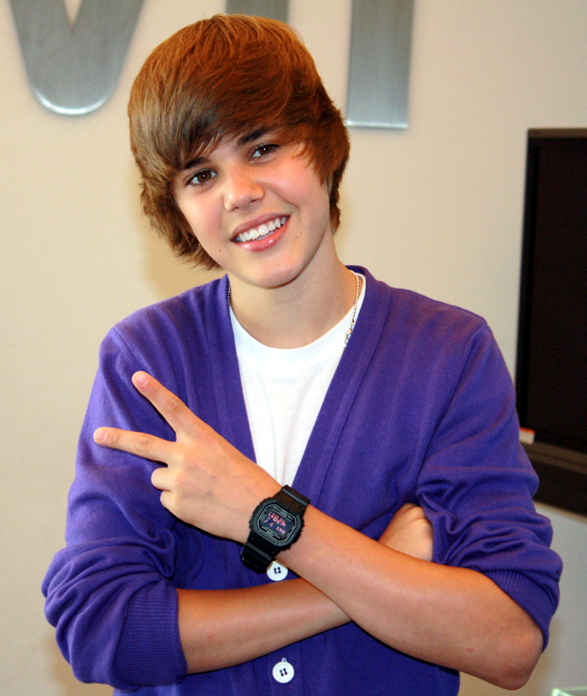
Justin Bieber, YouTube music sensation.
CC: Kevin Aranibar of Kerosene Photography
For instance, in the times before musical instruments the musician might have sung or banged out rhythms with sticks or rocks. Yet at another time in history, they might have played an instrument or conducted an orchestra. And again in more recent history, they might have been part of a rock band or a deejay or record producer. Finally, in today’s very digital age, they might be a digital composer, an artist who remixes found audio or a young man singing in their bedroom and posting their songs on YouTube. The artist does not seek to create as a means to amuse themselves or pass time; the artist creates because they need to express themselves and want to send a message. To that end, they will use whatever technology suites their talents and allows their audience to sense the message. As Marshall McLuhan says, “the serious artist is the only person able to encounter technology with impunity, just because he is an expert aware of the changes in sense perception” (McLuhan, 1964, p. 208).

Marshall McLuhan at the CBC.
(c) - marshallmcluhan.com
McLuhan also says, “we shape our tools and soon after they shape us” (McLuhan, 1964). In that statement he is suggesting that technologies form such a significant role in our society that people adapt behaviours as they become more prolific users. This notion might support Huxley’s assertion that people become passive because of the passive nature of consuming content that is enabled through machinery. This would be true, but technology does not seem to fundamentally change the character of the user. Technology may change the way that one behaves or engages, but it will not substantially adjust the character of the person. Someone who has artistic talent will find a way to use the technology available to them to express themselves, and those who have less artistic inclination will not suddenly become artistic because a new medium is available. There is likely to always be a segment of people who are performers and a segment of the population that will be part of the audience. This is not to suggest that being creative is a trait that is binary, but rather that people might sit on a continuum related to their level of creativity, exhibitionism or artistic talent.

Transliteracy? A One man band (circa 1865).
Photo by Knox, O.C.
The interesting thing about artistic talent is that those who are strong in one art tend to be strong in others as well. A musician will play multiple instruments; a visual artist is likely to create using collage, sculpture and different paints on different platforms; a writer might write fiction, poetry and essays as well as plays. Similarly, it would be very common for a musician to excel in dance, for an actor to take up writing or for a sculptor to dabble in architecture. People who use multiple mediums and platforms for creativity would have done so in the time before machines, in the time of Huxley and they continue to do so in today’s very digital age.

The ability to communicate in more than one medium is not exclusive to artists. In fact, it is a set of skills of growing importance in our increasingly digital world, accurately described using the term transliteracy. According to Sue Thomas, transliteracy scholar and author of transliteracy.com, “transliteracy is the ability to read, write and interact across a range of platforms, tools and media from signing and orality through handwriting, print, TV, radio and film, to digital social networks” (Thomas et al, 2007). As more technologies emerge, humans are not becoming more passive, rather they are becoming more active. Howard Rheingold is quoted as saying, “[w]hat we are witnessing today is [thus] the acceleration of a trend that has been building for thousands of years. When technologies like alphabets and Internets amplify the right cognitive or social capabilities, old trends take new twists and people build things that never could be built before” (in Thomas et al, 2007).

The advent and expansion of machinery, as Huxley calls it, has not inhibited artistry in any way. Some people still pick up the guitar for amusement, others don ballet slippers and now some people open their laptop and create stories using the full power of the tools available to them. Andy Campbell is a digital writer and author of the website Dreaming Methods. As a new media author he publishes stories that take full use of the digital technology and incorporate multiple media into a single cohesive narrative. The “reader” will read printed words on a screen that might be written overtop of a static image while music plays. When a hyperlink is clicked, the screen transforms, words fade or emerge and a video begins to play. These digital narratives effectively incorporate text, sound, music, visual arts, graphic arts, animation and video into one piece that creates a rich narrative experience. Campbell is a prime example of a transliterate creator. Rather than sitting still and allowing professionals to entertain him, he is using the tools available to him in complex, integrated and creative ways to express himself.

Aldous Huxley was perhaps limited in his perspective in 1927 about the power of machines for creative purposes, but nonetheless his assertion of machines by their nature affecting passivity amongst the creative class is simply incorrect. But, perhaps Huxley’s message needs to be heeded as a warning. There is a risk that in a society with pervasive content where creativity is not nurtured and where skills of transliteracy are not developed, we could end up with more and more citizens who are lulled by entertainers into an atmosphere of passivity. Combating this risk would require ensuring that citizens are taught a set of skills that encourage activity using digital technologies.

In his essay, Participative Pedagogy for a Literacy of Literacies, Howard Rheingold writes, “if the humans currently alive are to take advantage of digital technologies to address the most severe problems that face our species and the biosphere, computers, telephones and digital networks are not enough. We need new literacies around participatory media, the dynamics of cooperation and collective action, the effective deployment of attention and the relatively rational and critical discourse necessary for a healthy public sphere (Rheingold, 2007).” Rheingold provides a compelling case for a new pedagogy that helps ensure the full participation of young people. In talking about important participatory literacies, he does not speak specifically about the need for creative but others do. “Expanding literacies for learning include criticality, metacognition, reflection, and skills for creating and publishing content” (Asselin & Maoyeri, 2011, p. 1).

In conclusion, let us not take Huxley’s doubt “that general artistic culture can flourish in this atmosphere of passivity” as a fait accomplis, instead let us take it as a call to action to ensure that our artists, and citizens in general, may maintain a creative edge in this new age of machinery.


References


Asselin, M. & Moayeri, M. (2011). The Participatory Classroom: Web 2.0 in the Classroom. Practical Strategies – Literacy Learning: the Middle Years: 19(2).

Huxley, A. (1927). The Outlook for
American Culture: Some Reflections in a Machine Age. Harper’s Magazine, August, 1927.

McLuhan, M. (1964). Understanding Media: The Extensions of Man. New York: McGraw Hill.

Rheingold, H. (2007). Participative Pedagogy for a Literacy of Literacies. Retrieved April 3, 2011, from: http://freesouls.cc/essays/03-howard-rheingold-participative-pedagogy-for-a-literacy-of-literacies.html.

Thomas, S., Joseph, C., Laccetti, J. Mason, B., Mills, S., Perril, S., & Pullinger, K. (2007).  Transliteracy: Crossing Divides. First Monday, Volume 12 Number 12 - 3 December 2007. Retrieved March 23, 2011, from: http://firstmonday.org/htbin/cgiwrap/bin/ojs/index.php/fm/article/viewArticle/2060/1908

Monday, April 2, 2012

Week 12: Guest Lecture from Kate Pullinger

Is Literature Evolving? Kate Pullinger


Publishing is changing rapidly, and writing, reading and bookselling are changing with it, as is the book itself: there is no escaping this fact. While writers are urged by their publishers to engage with social media in order to market their books, storytelling itself is evolving with the new technologies.

I’ve been writing books – novels and short stories – for more than twenty years now, and writing digital fiction for a decade. In 2001 I was asked to teach a creative writing course online which, in turn, led to a year-long AHRB research fellowship at NTU, looking at new forms of narrative online. I began to experiment with hybrid forms of literature during that year – writing stories that combine image, video, animation, sound, music, etc. with words on the screen – and since then I’ve continued to write both books and digital fiction.

Moving online had as profound an effect on me as a writer as publishing my first book did. Beginning to create works of digital fiction forced me to consider the future of publishing, indeed, the future of writing and reading itself, much more deeply than I could ever have anticipated.

A bound book is a technology for reading, created by a printing press, moved from warehouse to retailer to reader via a network of transport technology, conveying the writer’s words to you in a manner to which you are completely accustomed; a technology you were taught to use on your mother’s knee, most likely. But many people are deeply attached to books, myself included, for reasons much more complex than the simple statement ‘I like to read’ could ever convey. The book-lined room is a status symbol as potent as the most expensive hand-printed wallpaper; the desk surrounded by books is as significant an image of intellect as that photograph of Einstein with his hair standing on end. The positions of The Book and The Writer in our culture are laden with layers of meaning, and digitization disrupts and transforms both these things.

As a fiction writer, I’m not really interested in the technological platform itself, be that bound book, e-reader, or web browser. What I am interested in is writing. What I am interested in is language; words, crafted, precise and beautiful; and the way that the right words in the right order can create mental pictures as indelible as the greatest film or photograph or painting. I am interested in what happens when words are liberated from the book – what happens to language, what happens to reading? What does it mean to put text on a screen, to use text combined with other forms of media?

Pundits bemoan the fact that young people are reading fewer books - though actual research on the effect of the internet on reading is in its infancy - but for the under-twenties, the born-digital generation, the acts of reading and writing have been fundamentally altered by the digital age already. With this in mind, it could be argued that the novel, as defined as a single work by a single author aimed at the solitary reader published on paper using fixed print type – or an electronic replica of that - is a relic of a cultural moment, a moment that lasted more than two hundred and fifty years or so but – as all you scholars of the history of literature know - in the context of humanity’s immense shared history of story-telling, a moment nonetheless. The new technologies enable the integration of story and community, writer and reader, media and text; they provide a platform for interactivity and response that we’ve only just begun to explore. It’s the hybrid forms that are now emerging that interest me, as both a writer and a reader. Literature is evolving.


What do you think a Literature of The Future will look like?


http://www.katepullinger.com

Week 12: Writers and Publishing


What does it mean to publish in the web 2.0 world?
Some key terms we will discuss during this  session:
  • digital storytelling
  • affordances
  • new media platforms
  • audience
  • open source
  • print on demand
  • self-publishing
  • e-readers

Open Publishing
When thinking of “open publishing” the first things to probably springs to mind are people like Lawrence Lessig, Cory Doctorow and Tom Reynolds who have all persuaded their publisher to allow them to release electronic versions of their books at the same time as the physical dead-tree version. (More on those three later.) In all cases, this seems to have been to the benefit of the book, but to give your book away at the same time as you put it up for sale is a bit of a leap of faith. Why would you take that risk? It’s far from being a proven economic or promotional strategy.
I think Chris Saad gets to the heart of this very quickly, when he asks, Am I being heard? He says there is:
“A fundamental human need that I think podcasting, blogging and all forms of social/citizen journalism speaks to… the need to be heard. People just want to feel connected and understood.”
~http://www.touchstonelive.com/blog/2006/04/am-i-being-heard.html
At a very basic level, Larry, Cory and Tom share in common with me, you, and pretty much everyone else a desire to be heard, to be read, to have the things that we’ve laboured over appreciated.
Chris Anderson, editor of Wired and author of The Long Tail, also confesses that he just wants to be heard (although he doesn’t seem to have published an ebook version of his book):
Anderson, however, tangles up a few threads in his piece, the first is a discussion of equivalence: ebooks are assumed not to be equivalent to books; digital audiobooks are assumed to be equivalent to CDs.
Reading an ebook isn’t currently a great experience (the iPad however might be the game-changer). Specialised e-book readers are expensive, and most people don’t like reading on-screen, so the ebook is seen as not equivalent for a paper book, i.e. people are more likely to go and buy the paper version if they like the ebook. Thus it is beneficial to release a free ebook so that you can reach as wide an audience as possible, as you stand a good chance of converting ebook downloads to paper book sales.
Conversely, it doesn’t really matter whether you have an unlawfully downloaded copy of an audiobook, or the real thing, whether bought as a download or as a CD, because either way you are probably going to listen to it on your iPod, computer or other MP3 playing device. The assumption is that giving away ebooks encourages sales of paper books, but giving away audiobooks, or allowing unauthorised downloads, will cannibalise the sales of the legitimate ebook. This is exactly the same logic as used by the RIAA and BPI for suing file-sharers, and the rest of the music industry for attempting to slap DRM onto everything in sight. It’s a very compelling and sensible looking argument, but it’s based on unproven assumptions behind the motivations of the downloader/buyer.
Right now, there are more questions than answers. The publishing industry is being pushed into experimentation in a way that the music and movie industries are not (one example is  the Million Penguins wiki-novel). Authors are forcing publishers to do things that might seem counterintuitive, and we’re slowly starting to figure out, through trial and error, what all this means. Still lots to find out, though, about this open publishing idea.
Update Nov. 2010: Lawrence Lessig responds to the “outrage” about his talk on a panel at Vimeo's Festival+Awards. The title of the panel was "Know your digital rights." See Lessig’s response in the 17th Nov. 2010 Huffington Post: http://www.huffingtonpost.com/lawrence-lessig/the-imbecile-moron-respon_b_764725.html